New technology helps police tackle illegal e-bikes in Nottingham city centre
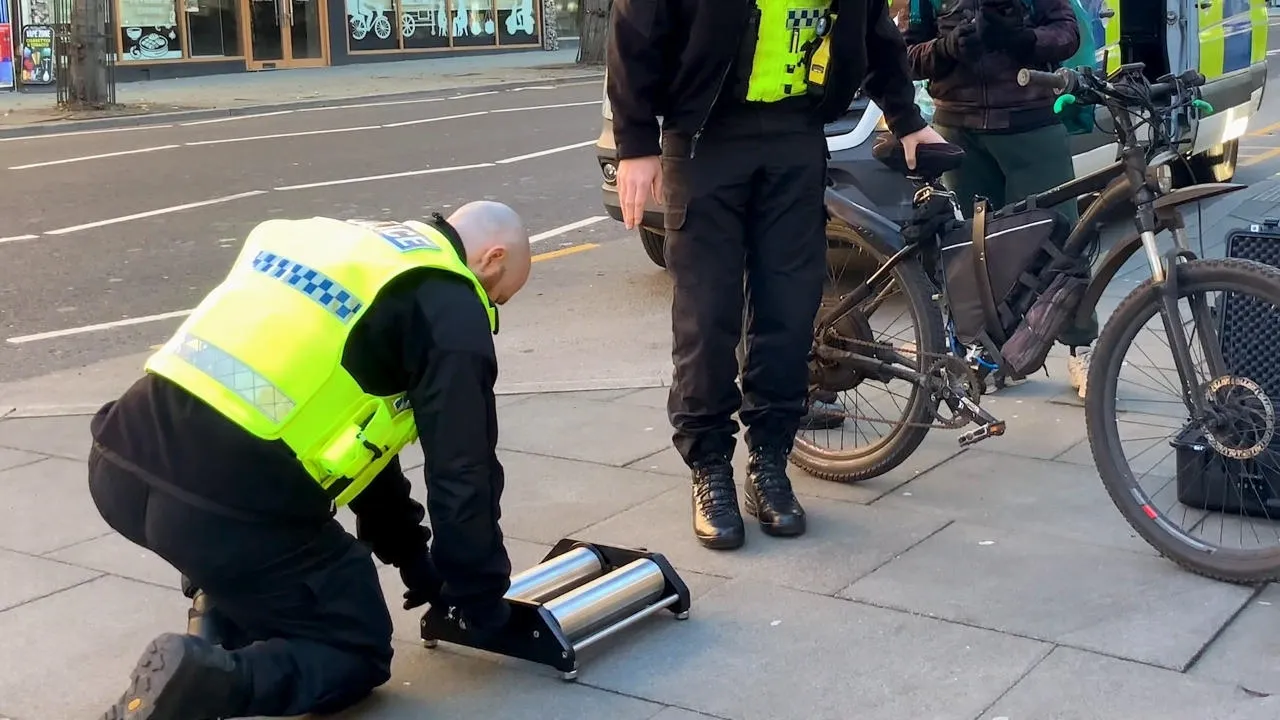
Police have unveiled a new tool in their crackdown on overpowered e-bikes in Nottingham city centre.
For the first time, officers are using a compact dynamometer to test the top speed of e-bikes, as well as private e-scooters.
Under UK law, the electric motor must disengage once the bike or e-scooter reaches 15.5 mph (25 kmph) for it to be ridden in a public place.
The new device, made by Swiss company Wenger and funded by the Office of the Nottinghamshire Police and Crime Commissioner, is enabling neighbourhood officers to measure the peak speed of an e-bike or e-scooter without needing a full test track or laboratory.
It involves officers placing the two-wheeled device onto the dynamometer and accelerating the back wheel, with a digital readout telling them how fast it can go.
Where it fails to comply with the law, the bike or scooter is seized.
Officers are using the new device as part of Operation Wrangel, which was launched by the City Centre Neighbourhood Policing Team in November to tackle crime and antisocial behaviour linked to the illegal use of two-wheeled vehicles.
The operation is particularly targeting e-bikes as feedback from the public suggests they are people's top concern when walking in the city centre.
“That’s why I’m happy that the Office of the Police and Crime Commissioner was able to fund the purchase of this vital tool, the use of which is backed by proactive operations like Wrangel, because neighbourhood officers need the right tools to deal with what communities are seeing on their streets.
“This new testing equipment gives officers the ability to take swift, decisive action against vehicles that are being used to intimidate residents, move drugs and avoid police.
“It’s a really practical example of how we’re investing in modern policing to keep Nottinghamshire safer, support our neighbourhood teams, and restore confidence in our city centre.”
PC Ben King, of the City Centre Neighbourhood Policing Team, said the new device is helping officers tackle an issue that has been a growing concern for some time.
He said: “Overpowered e-bikes and e-scooters are becoming a growing issue nationally and remains the number one concern raised by people in Nottingham city centre.
“Many riders modify their motors or install ‘speed unlockers’ to bypass factory limits, turning them into lightweight electric motorcycles without the required registration, insurance, or safety gear.
“We’re increasingly finding illegal modifications, and tools like this portable device make enforcement easier than ever.
“We know members of the public have had enough of nuisance and illegal riding in the city centre and this device is helping us tackle the issue head on.”
The term ‘e-bike’ is a generic term used to describe all two-wheeled electric vehicles. Some e-bikes are legal to use on a road or other public places just like a standard pedal cycle. These legal e-bikes must conform to the Electrically Assisted Pedal Cycle (EAPC) regulations.
EAPCs are legal to ride without a licence or insurance if the rider is aged 14 or over and the bike meets the following criteria:
- the motor must have a maximum output of 250 watts
- the motor must only assist while pedalling (not via a ‘twist and go’ throttle/accelerator)
- the electric motor must disengage once the bike reaches 15.5 mph (25 kmph)
- the bike must display manufacturer information, battery details, maximum speed, and power output, either on a securely fitted plate or clearly marked on the frame.
If an e-bike does not meet these criteria, it is classed as an electric moped or electric motorcycle and must comply with relevant laws, including registration, insurance, helmet use, and appropriate licensing.
Under current UK law, private e-scooters cannot be ridden on public highways or in public spaces. They are only legal to use on private land with the landowner’s permission.
If you don't have the correct licence or are riding without insurance in a public space, you could face a Fixed Penalty Notice, which may include a large fine and penalty points on your licence.
If you're using an e-bike that does not conform to the EAPC Regulations, on a road or in a public space, or an EAPC in an antisocial manner, you also risk the vehicle being seized.
To combat non-compliance in Nottingham city centre, neighbourhood officers seized 34 e-bikes for failing to comply with the law between 3 November last year and 5 January, with 24 riders facing subsequent court proceedings for having no licence or insurance.
Forty-eight education packs were also distributed as part of the operation over the same period.
Sergeant Dan Butler, who leads Operation Wrangel, said these numbers are continuing to rise as more enforcement days are held.
He said: “The reckless use of e-bikes, off road motorcycles and e-scooters are more than just a nuisance to communities, they are being used to commit serious criminal activity including drug supply, weapons offences and violence.
“The public can expect to see various operations targeting two-wheeled vehicles over the coming months and beyond, to provide a visible presence and disrupt offenders.”
Nottinghamshire Police and Crime Commissioner Gary Godden welcomed the launch of Operation Wrangel.
He said: “Overpowered e-bikes and illegal e-scooters might look like a nuisance on the surface, but in reality they are often being used to fuel serious crime and put innocent people at risk.
If you see any illegal use of e-bikes, e-scooters, or electric motorcycles, please report it to Nottinghamshire Police as soon as possible by calling 101 or 999 in an emergency. Other ways to contact them can be found here: Contact us | Nottinghamshire Police.